Introduction
If you have a child with ADD/ADHD, you have probably heard the same suggestions over and over. Try medication. Try behavioral therapy. Try more structure at home. And while these approaches have their place, many parents want to explore what actually works before turning to daily prescriptions.
As a certified educator with more than thirty years of experience supporting children with ADD/ADHD, I can tell you that natural, non-medicated approaches genuinely work when they are done correctly. This is not wishful thinking. This is what I have seen consistently across hundreds of students.
This guide covers the natural strategies that produce real results for children with ADD/ADHD, why the educational environment matters more than most families realize, and how to build a support system that helps your child thrive without medication.
Why Parents Are Looking for Non-Medicated Options
There are many reasons families explore natural approaches to ADD/ADHD support. Some have tried medication and found the side effects unmanageable. Some have medical reasons to avoid stimulants. Some want to try every other option first before considering medication. And many simply want their child to have every advantage that does not involve a daily prescription.
Every one of these reasons is valid. And every one of these families deserves accurate information about what actually helps children with ADD/ADHD succeed in daily life.
The Foundation: The Right Learning Environment
The single most important intervention for a child with ADD/ADHD is the environment they spend six to eight hours a day in. The classroom itself either supports their brain or works against it. And most traditional classrooms are working against them.
Twenty-five children, fluorescent lights, long periods of seated work, constant transitions, complex social dynamics, and a teacher whose attention is divided across too many students. For a child with ADD/ADHD, this environment creates daily overwhelm. Change the environment, and everything else becomes easier.
Small class sizes of six to eight students. Teachers trained specifically in ADD/ADHD instruction. Movement built into the day. Quiet workspaces. Clear expectations. Immediate redirection when attention wanders. This is the foundation on which every other natural strategy actually works.
Strategy 1: Sleep, Movement, and Nutrition
The research on this is detailed and often overlooked. Children with ADD/ADHD respond significantly to the basics of physical health.
Sleep matters more than most families realize. Children with ADD/ADHD often struggle to fall asleep because their brain has difficulty settling. Aim for ten to eleven hours per night for elementary-age children. Remove screens at least one hour before bedtime. Establish a calm evening routine that signals sleep is coming.
Movement is medicine for the ADD/ADHD brain. Daily physical activity, especially in the morning, dramatically improves focus, mood, and impulse control throughout the day. This does not need to be organized sports. It can be a thirty-minute walk, jumping on a trampoline, riding a bike, or active outdoor play.
Nutrition affects attention more than parents often think. Protein at breakfast supports sustained focus through the morning. Limiting added sugar reduces the blood sugar swings that worsen attention. Consistent hydration matters. These are not magic solutions. But together, they create a foundation that makes every other strategy more effective.
Strategy 2: Executive Function Coaching
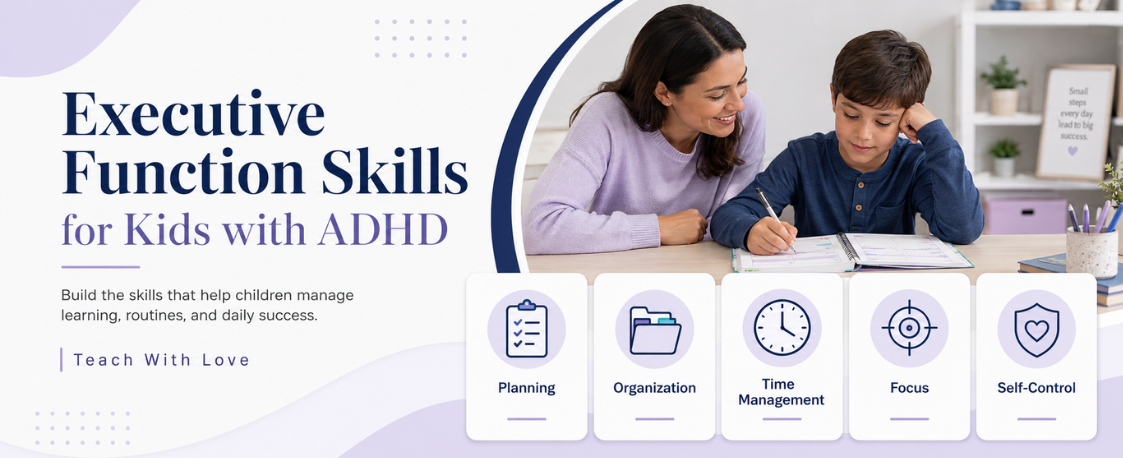
Executive Function is the brain’s ability to plan, organize, prioritize, and complete tasks. It is where most children with ADD/ADHD struggle the most. And the good news is that Executive Function can be taught, one skill at a time, through consistent daily practice.
A child with ADD/ADHD does not need to be told to be more organized. They need a system. A visible, repeatable system for getting ready in the morning, tracking homework, managing assignments, and completing tasks. When these systems are practiced patiently over months and years, children develop the skills that let them function independently as adults.
At Teach With Love, Executive Function coaching is woven into every day. Children learn how to break tasks into steps, use checklists effectively, manage time visually, and recover when they feel stuck. These skills build slowly, but they build permanently.
Strategy 3: Emotional Regulation
ADD/ADHD is not just about attention. It is also about emotion. Children with ADD/ADHD often experience emotions more intensely than their peers. Frustration turns into meltdown. Disappointment turns into despair. Excitement turns into overwhelm.
Teaching emotional regulation does not mean teaching a child to suppress their feelings. It means helping them recognize what they are feeling, understand why, and develop healthy ways to respond. This work requires calm, patient educators and parents who do not punish big feelings but guide children through them.
Over time, children develop the internal language and coping strategies to manage their own emotional world. This transformation is real, and it is one of the most rewarding aspects of watching children with ADD/ADHD grow into confident young people.
Strategy 4: Understanding Your Child’s Specific Type
Here is something most families are never told. ADD/ADHD is not one condition. There are seven distinct types, each with different brain patterns, different challenges, and different responses to different strategies. What works for one type will not work for another.
Before any natural approach can be fully optimized, you need to know which type your child has. This requires a proper brain health assessment, not a quick screening. Our Assessment Division specializes in identifying the specific type of ADD/ADHD your child has and building a customized plan around it.
When you know the type, everything else becomes clearer. The strategies you try have a much higher chance of working. The frustration of trying random suggestions and hoping something sticks disappears. You finally understand your child.
Strategy 5: A School Built for How Your Child Learns
Every strategy above works best inside an educational environment that supports it. Trying to layer natural approaches onto a traditional school environment that is actively working against your child is exhausting for everyone.
A school built around how children with ADD/ADHD actually learn is different. Movement is built into the day. Executive Function is taught alongside every subject. Emotional regulation is supported throughout. Class sizes stay small. Teachers are trained. And the whole focus is on helping each child develop the skills they need for lifelong success.
This is exactly what we built at Teach With Love. Our accredited online MicroSchool was designed from the ground up for children with ADD/ADHD, Dyslexia, and Executive Function challenges. Every element supports the natural, non-medicated approach that so many families are looking for.
What Real Change Looks Like for Families
The parents who come to us are usually exhausted. They have tried multiple schools. They have hired tutors. They have sat in countless meetings. They have watched their child slowly stop believing in themselves. And they are searching for something that will finally work.
When we combine the right environment, the right instruction, and the right natural strategies, real change happens. Not overnight. Not through magic. But within weeks, parents start to see their child return. The light comes back into their eyes. They enjoy learning again. They start believing they are capable.
This is the work I have dedicated my career to. Not because non-medicated ADD/ADHD support is a philosophy, but because for the right family, with the right plan, it produces real, lasting results.
How to Get Started
If you are a family in Florida, Texas, Nashville, or anywhere in the United States, considering natural, non-medicated support for your child with ADD/ADHD, the first step is a real conversation about your child’s specific situation.
Schedule a free consultation with our team. We will listen to what you have already tried, ask the right questions, and help you understand whether our MicroSchool, our Tutoring Division, or our Assessment Program is the right starting point for your family.
For Florida families, your child’s tuition may be fully covered through the Family Empowerment Scholarship. For Texas families, TEFA funding may cover the cost. For Nashville families, the ESA program is available. And for every other family, we serve students nationwide through our online MicroSchool.
Your child has a brain that learns differently. That is not a problem to fix. It is a reality to work with. And with the right support, the right environment, and the right plan, the future you want for your child is completely within reach.